
Shop Local
Small-batch, natural products from local Texas artisans. Visit our stores in Lake Highlands & Bishop Arts, or ship nationwide.

Walk down the soap aisle at a drugstore and you'll see hundreds of products — body washes, cleansing bars, moisturizing bars, "beauty bars." Most of them aren't soap. Not legally, not chemically. The word "soap" is tightly defined, and a lot of what gets sold in that aisle doesn't qualify.
Here's what actually separates a real bar of soap from the rest of the shelf.
Soap, in the chemical sense, is made through a process called saponification: oils or fats combined with an alkali (in cold-process soap making, sodium hydroxide) undergo a reaction that transforms them into soap molecules and glycerin. The result is a true soap — a surfactant molecule with one end that attracts oil and one end that attracts water, which is how it lifts dirt and rinses clean.
The FDA has a specific definition for soap that depends on this chemistry. To be legally labeled as "soap," a product must be made primarily of alkali salts of fatty acids — which is exactly what saponification produces. Products that don't meet this definition have to be regulated as cosmetics or drugs, even if they're sold in bar form and marketed as soap.
Most mass-market cleansing bars and body washes don't meet this definition. They're synthetic detergents — surfactants derived from petroleum or other synthetic sources — formulated to mimic what soap does but manufactured through an entirely different process. You'll see them listed as sodium lauryl sulfate, sodium laureth sulfate, ammonium lauryl sulfate, or similar. These are effective cleaners, but they're not soap.
When real soap is made, glycerin is a natural byproduct of saponification. It's a humectant — it draws moisture — and in handmade cold-process soap, it stays in the bar. That glycerin is part of why real soap feels different on your skin.
In commercial soap manufacturing, glycerin is typically extracted from the soap and sold separately — it's a valuable ingredient in lotions, cosmetics, and pharmaceuticals. What's left is soap without the glycerin, which is why commercial bars can feel dry or tight after use. The glycerin went somewhere else.
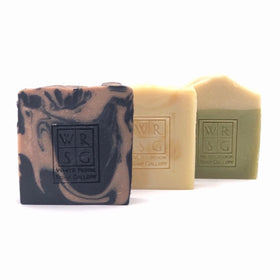
Every WRSG bar keeps its glycerin intact. It's not added back after the fact — it was never removed. It's there because that's what happens when you make real soap from scratch.
Flip over a bottle of commercial body wash and read the ingredients. You'll typically find water as the first ingredient, followed by synthetic surfactants, preservatives, fragrance (listed as a single word that can represent dozens of undisclosed compounds), thickeners, and colorants.
The ingredient list on a WRSG bar looks completely different: saponified oils (olive oil, palm oil, coconut oil, castor oil, avocado oil), sodium citrate (from citric acid), sodium lactate, essential oils, and natural colorants. Every ingredient is there for a reason and every one of them is identifiable.
Many commercial cleansers are marketed with moisturizing claims — "leaves skin feeling soft," "with moisturizers," "hydrating formula." These claims are regulated differently than what a bar of real soap can say, which is one reason you'll see aggressive moisturizing language on commercial products and more restrained language on handmade ones.
What we can tell you: our bars are made with a 6% superfat — meaning roughly 6% of the oils in every bar are intentionally left unsaponified as free conditioning oils. That's a deliberate formulation choice, not a marketing claim. The oils are in the bar.
This is a personal choice, and there are situations where a synthetic cleanser makes sense — certain skin conditions, specific formulation needs, medical contexts. We're not making any claims about what's right for anyone's skin.
What we will say is this: if you've been using commercial body wash your whole life and you've never tried a bar of real cold-process soap, it's worth experiencing the difference. The lather is different. The rinse is different. The way your skin feels afterward is different. Whether that difference matters to you is something you'll know after the first bar.
Our Lake Highlands and Bishop Arts stores carry our full WRSG line plus curated soaps from top Texas artisan soap makers. Come in and find yours.