
Shop Local
Small-batch, natural products from local Texas artisans. Visit our stores in Lake Highlands & Bishop Arts, or ship nationwide.

Walk into any big-box store and pull a candle off the shelf. Turn it over and look for the wax type. Most of the time, if it says anything at all, it'll say paraffin. Sometimes it'll say "soy blend" — which usually means mostly paraffin with a small amount of soy wax mixed in.
Paraffin is cheap, widely available, and burns consistently. It's also a byproduct of petroleum refining — the residue left over after crude oil is processed for gasoline, diesel, and lubricants. That doesn't automatically make it dangerous, but it does matter when you're deciding what to burn in your home for hours at a time.
Here's how soy wax actually compares.
Paraffin is derived from crude oil. It's a waxy solid that separates out during the refining process and is used in everything from candles to food coatings to cosmetics. It's inexpensive and easy to work with, which is why it dominates the commercial candle market.
Soy wax is made from soybean oil — hydrogenated to raise its melting point until it becomes a solid wax. It's a renewable, plant-derived material, and in the US, most soy wax is made from American-grown soybeans. We use American-grown soy wax in all of our candles.
Soy wax has a lower melting point than paraffin, which means it burns cooler. Cooler burning has a few practical effects:
A lot of candles are marketed as "soy" or "natural" when they contain only a small percentage of soy wax blended with paraffin. There's no regulatory standard for this — a candle can legally be called a "soy blend" if it contains any amount of soy wax at all.
Our candles use a blend of three natural waxes: American-grown soy wax, coconut wax, and a small amount of beeswax. Each ingredient is there for a reason.
Soy wax forms the base — it's clean-burning and slow-melting. Coconut wax adds a smooth, creamy finish and improves fragrance throw. Beeswax has a higher melt point than soy or coconut, which firms up the blend and produces a particularly steady, bright flame — important in a Dallas summer when a purely soy candle can soften on a warm shelf.
Because our candles contain beeswax, they are not vegan. We're upfront about that. If you're looking for a fully plant-based candle, ask our staff — we carry a line of 100% coconut oil candles that may fit what you're looking for.
Every candle we pour is paraffin-free. That's a deliberate choice — we wanted a candle we'd be comfortable burning in our own homes and stores, and paraffin didn't make the cut. Whether that matters to you is your call, but it's part of why we make what we make.
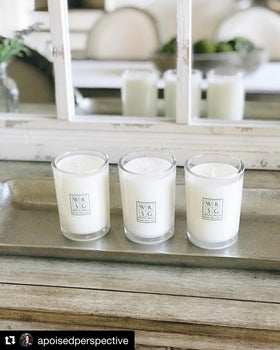
Our hand-poured candles are available in both Dallas locations — Lake Highlands and Bishop Arts — in 3.5 oz votives, 8 oz glass jars, and 26 oz three-wick formats. Want to know how to get the most out of a soy candle once you have one? Read: How to Burn a Soy Wax Candle the Right Way.